How to Design an AI Agent: Architectures, Protocols, and Technical Evaluation
Chapter 2 of Agentic AI in Law and Finance focuses on the architectural principles required for agents to function as cognitive work systems in high-stakes domains.
Open Educational Resources
An open textbook series for legal and financial professionals navigating AI—from foundational LLM concepts to agentic systems and governance frameworks.
All content is freely available under Creative Commons licensing.
First Book Now Available
Agentic AI in Law and Finance
253 pages · Paperback & Digital
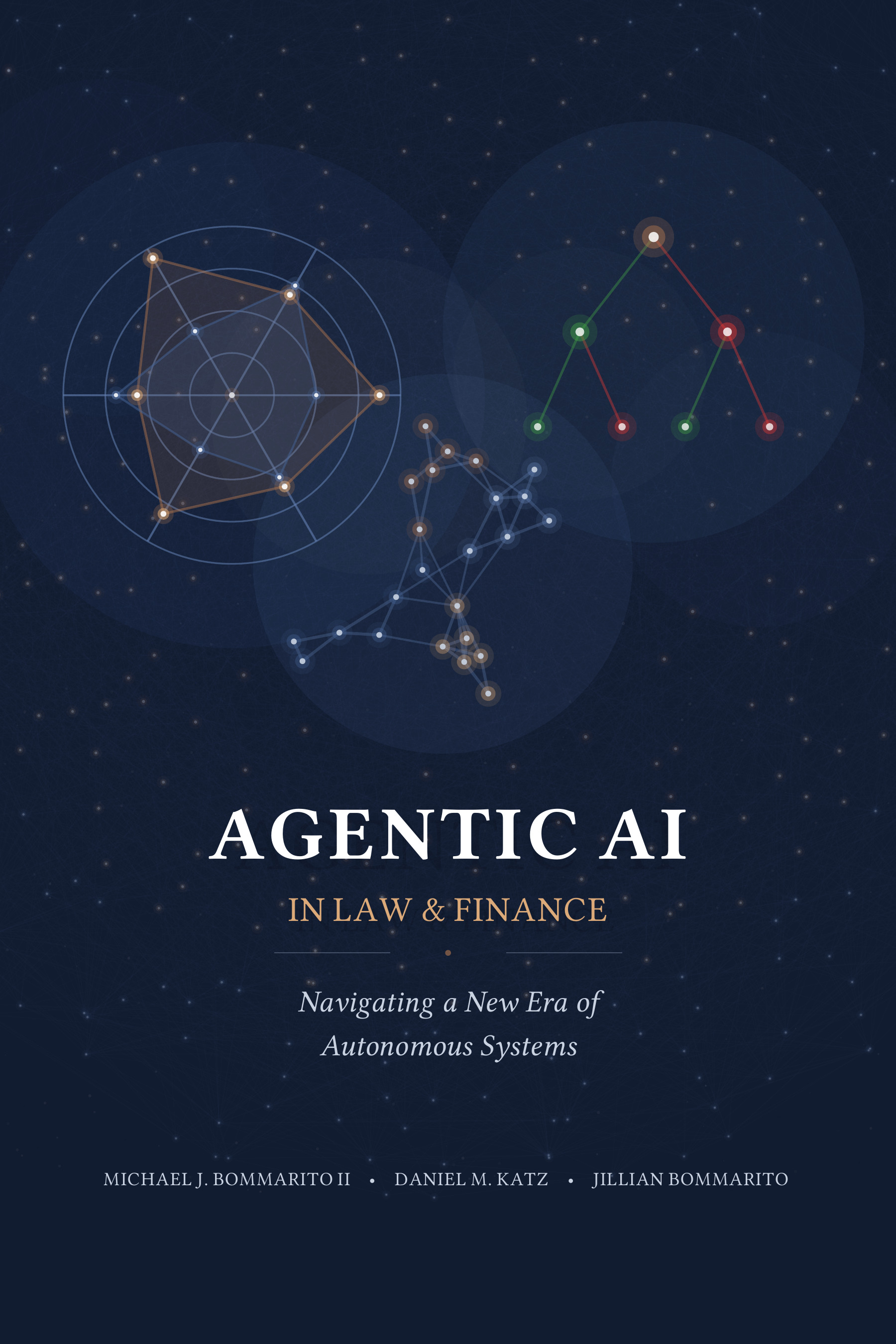
Each chapter is available as a standalone paper on SSRN
Chapter 2 of Agentic AI in Law and Finance focuses on the architectural principles required for agents to function as cognitive work systems in high-stakes domains.
Chapter 3 of Agentic AI in Law and Finance proposes a governance framework for scaling oversight requirements to match each system's risk profile in regulated industries.
Chapter 1 of Agentic AI in Law and Finance addresses the need for definitional clarity regarding 'agents' and 'agentic AI' by drawing on nearly a century of scholarship across eight disciplines.
Learn
Go beyond definitions with illustrated guides that break down complex concepts. Each article features custom diagrams and practical frameworks you can apply immediately.
Coming soon:
AI for Law and Finance is a collection of open educational resources designed for legal and financial professionals navigating the rapid emergence of AI. Written by academics and practitioners, it bridges the gap between technical implementation and professional obligation.
The project covers LLM fundamentals, agentic systems, and governance frameworks. Chapters are being released as working papers on SSRN, with print editions available as standalone books. All content is available under a Creative Commons license.
Now Releasing
A comprehensive guide to understanding, designing, and governing AI agents for high-stakes professional domains.
253 pages · Paperback and Hardcover
Coming Soon
From tokens to tool use—everything you need to work effectively with large language models in regulated industries.
420 pages · Paperback
59 essential terms for understanding AI agents in law and finance
Core Framework
A system exhibiting the three foundational properties of Goal, Perception, and Action (GPA). An agent pursues objectives, observes its environment, and takes actions to achieve its goals. This represents Level 1 in the three-level hierarchy.
Core Framework
The three foundational properties that define minimal agency. Goal provides direction, Perception enables environmental awareness, and Action allows the system to effect change. Together, they form the basis for all agentic behavior.
Governance
A governance model where humans approve each significant agent action before execution. HITL provides maximum oversight but limits throughput and is appropriate for high-stakes, irreversible actions.
Technical Patterns
A pattern that enhances language model responses by retrieving relevant documents from a knowledge base before generation. RAG improves accuracy and enables grounding in authoritative sources.
AI & Machine Learning
The generation of plausible-sounding but false or fabricated information by an AI system. In legal contexts, this includes invented case citations or nonexistent statutes; in finance, fabricated data or regulations. Hallucination risk requires verification controls and human oversight.
Legal & Economic
Legal obligations of loyalty and care that agents owe to principals, requiring agents to act in the principal's best interest rather than their own. When AI agents act on behalf of clients or organizations, questions arise about how fiduciary standards apply.
Researchers, practitioners, and educators at the forefront of legal and financial AI

Serial entrepreneur and researcher at the intersection of AI, law, and finance.

Legal technology innovator and professor applying AI to transform legal practice.

AI governance and compliance specialist helping organizations navigate emerging technology.
The book source is available on GitHub under a Creative Commons license. We welcome contributions, corrections, and feedback from the community.